
Sample: SLO6
- Monument: Slocene settlement
- Location: Tukums Municipality, Lapmežciems parish, shore of River Slocene
- Chronology: Middle Neolithic (3900-3000 BC)
- Kind: Pottery sherd
- Type: Comb Ware
- Publication: Haferberga (Visocka) et al. 2024
-
Description:
* Clay paste – medium coarse with various sized sand and silt, few ferric concretions and grains of mica (biotite) were distinguished as well (largest grain – 0,9 mm).
* Pores – some are uneven, asymmetric and elongated, others are small and round – oval shaped.
* Temper: grog + mussel shells + crushed granite + unidentifiable organic matter:
- Largest size of the grog grain – 3,7 mm, max. avg. – 0,8 mm;
- Largest size of the pore from mussel shells – 3,2 mm, max. avg. – 1,7 mm;
- Largest size of the crushed granite grain – 1 mm, max. avg. – 0,54 mm;
- Largest oval pore – 1 mm, max. avg. – 0,39 mm;
- Amount of the temper in the clay paste – 20,5%.
* Description of the largest grog grain – fine with few fine sand and silt grains, tempered with crushed granite (size – 0,5 mm) and mussel shells (2,1 mm). Oval small pores were identified as well (largest – 0,2 mm). Total volume of the temper – 9%.
! Values are recalculated using more precise methodology and differs from ones in the publication.
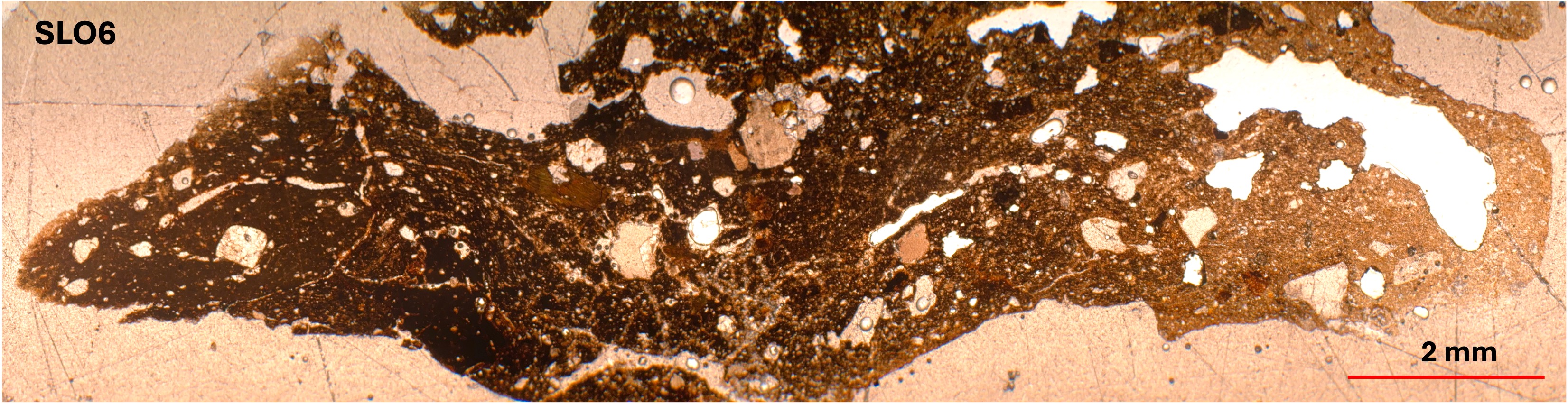
Overview of the sample thin section in plain polarized light. Photo: V. Haferberga.
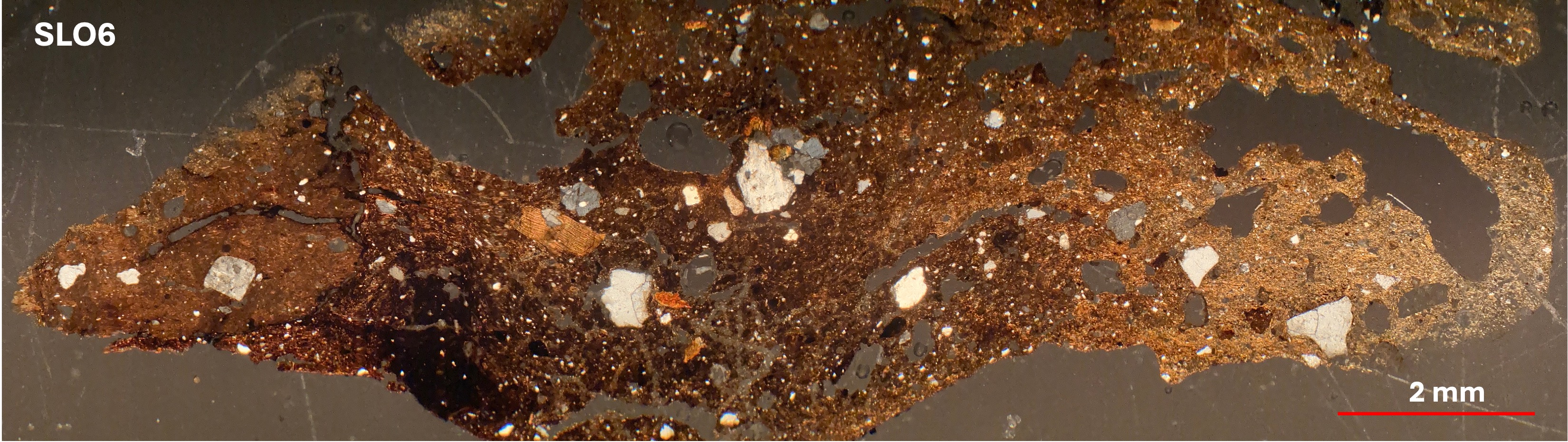
Overview of the sample thin section (created with smartphone on the panorama setting); Magnification – x40 (eye pieces x10, objective lens x4), crossed polarizers. Photo: V. Haferberga.
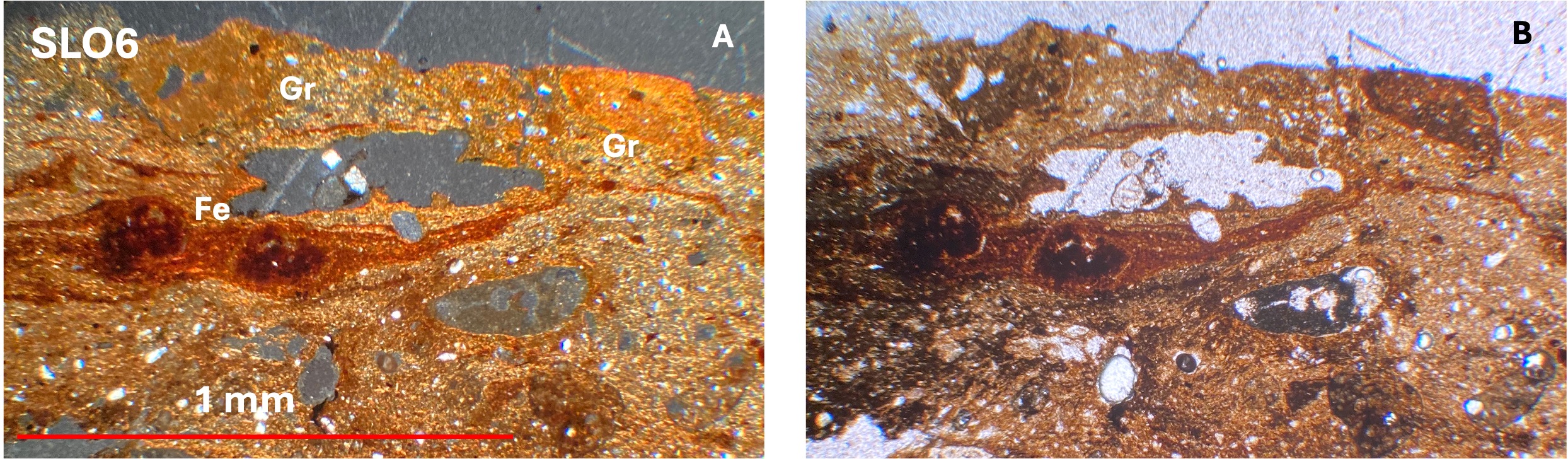
Ferric concretions (“Fe”) and grog grains (“Gr”) in the clay paste. Crossed (A) and plain (B) polarized light. Magnification – x100 (eye pieces x10, objective lens x10). Photo: V. Haferberga.
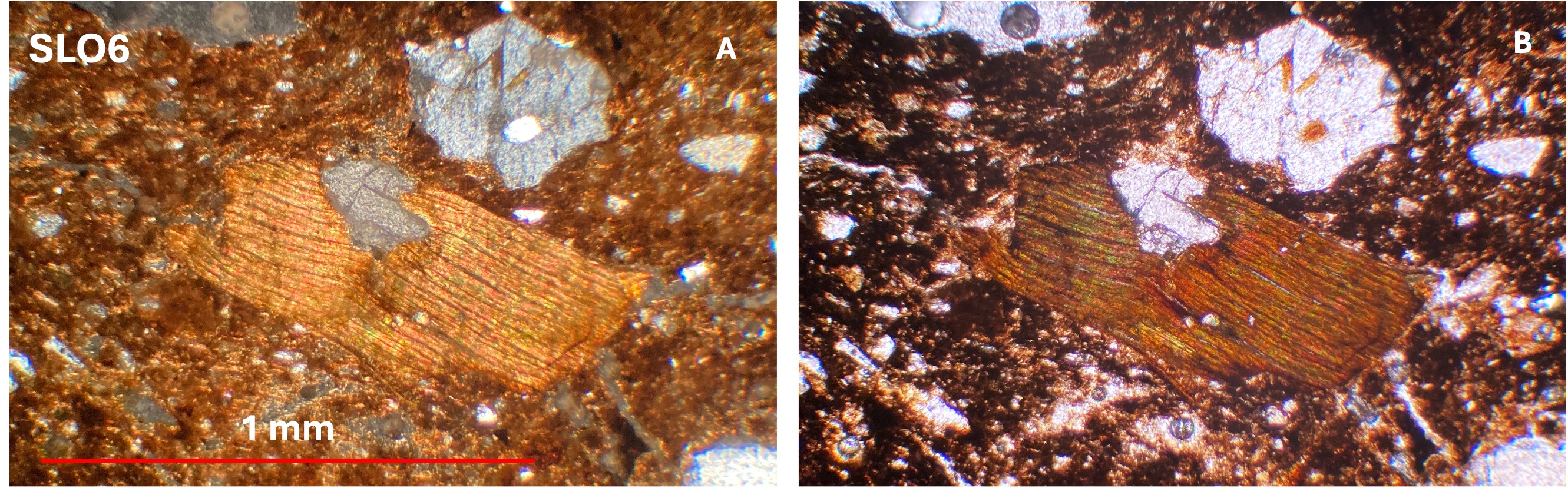
Biotite in the clay paste. Crossed (A) and plain (B) polarized light. Magnification – x100 (eye pieces x10, objective lens x10). Photo: V. Haferberga.
×
![]()